
What Drains a Car Battery Overnight in Boulder?
An overnight battery failure can come from a weak battery, a charging problem, or an electrical component that remains active after the vehicle is parked. Proper testing separates those causes before parts are replaced.
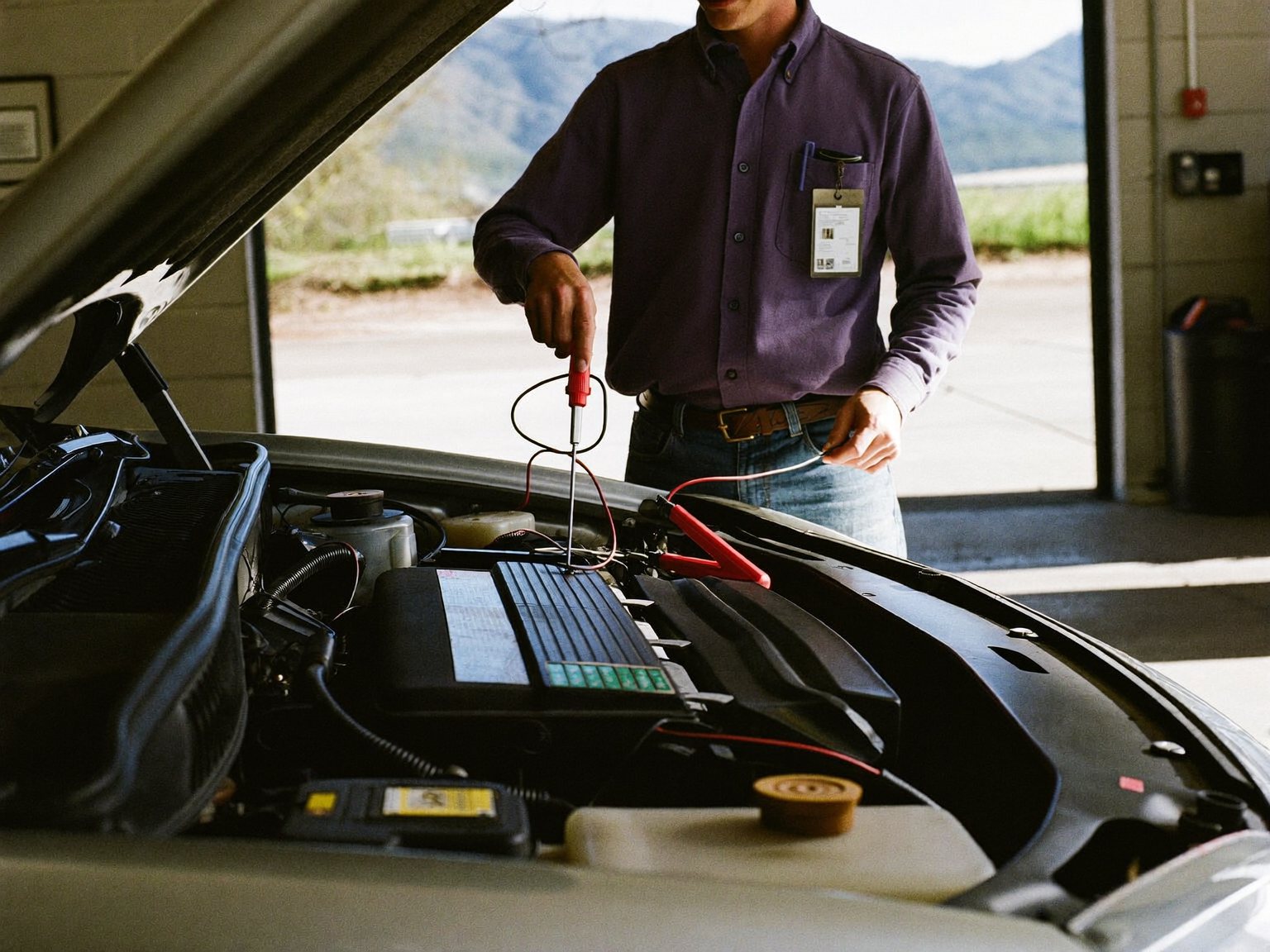
A car battery that dies overnight is usually being drained by an electrical component that does not shut off, or the battery is too weak to hold a charge. We test the battery, charging system, and key-off electrical draw to identify which condition is actually causing the problem.
An interior light left on is an obvious possibility, but modern vehicles can develop less visible problems. A control module may stay awake, an aftermarket accessory may draw power continuously, or a faulty latch sensor may tell the vehicle that a door is still open. Boulder’s cold nights can expose the problem because a weakened battery has less usable starting power, but cold weather by itself does not create a parasitic electrical drain.
Why a Battery Can Be Dead by Morning
A parked vehicle continues using a small amount of electricity. Security systems, clocks, keyless-entry receivers, and memory functions need power even when the ignition is off. That normal demand should not prevent a healthy battery from starting the vehicle after it sits overnight.
A parasitic drain occurs when a circuit continues consuming more power than the vehicle was designed to use while parked. The source might stay active all night, or it may wake up intermittently. Intermittent faults are especially frustrating because the vehicle can start normally for several days and then be completely unresponsive one morning.
Is the battery itself always the problem?
No, a dead battery is a symptom rather than proof that the battery is defective. A battery can fail internally, lose its ability to retain energy, or become unreliable after repeated deep discharges, but a healthy battery can also be drained by another component. We begin by evaluating battery condition and connections because parasitic-draw testing is not meaningful if the battery cannot accept and hold a proper charge. Corroded terminals, loose cable ends, and poor ground connections can also imitate a discharged battery by preventing current from reaching the starter.
Can the alternator drain a battery while the car is parked?
Yes, an alternator can contribute to an overnight drain if an internal electrical fault allows current to flow after the engine is off. It may also fail to recharge the battery fully during driving, leaving the vehicle with too little reserve by the time it is parked. We evaluate charging performance and check for unwanted key-off current rather than assuming every alternator problem will trigger a warning light. Replacing the battery alone will not solve a charging-system or alternator-related fault.
Common Sources of Parasitic Battery Drain
Modern vehicles contain networks of computers that communicate with one another. After the vehicle is locked and parked, those modules need time to complete tasks and enter sleep mode. If a module never goes to sleep, the battery continues supplying it.
Common causes include glove-box or cargo-area lights that remain illuminated, sticking relays, faulty door or hatch switches, seat-control modules, infotainment systems, alarm components, keyless-entry faults, damaged wiring, and equipment connected to an always-powered outlet. Dash cameras, phone chargers, audio amplifiers, remote starters, trailer wiring, and other aftermarket additions deserve particular attention if the battery trouble began after installation.
Moisture can matter too. Snow carried into the cabin, roof-rack leaks, clogged drains, or water intrusion near wiring connectors may produce corrosion or unintended electrical paths. The resulting drain may change as the vehicle dries, freezes, or warms, making the fault appear inconsistent.
Could a light be on even when the cabin looks dark?
Yes, a light can remain on in a closed glove box, center console, trunk, or cargo area where it is difficult to see. A misadjusted latch or failed switch can keep that light powered even though the panel appears securely closed. Some vehicles also use electronic lighting modules rather than simple mechanical switches, so the visible light may be only one clue in a larger circuit problem. We verify switch data and circuit behavior instead of relying only on a quick visual check.
Can a key fob keep the vehicle awake?
It can on some vehicles, particularly when a proximity key remains close enough for the car to detect it repeatedly. The exact behavior varies by model, and normal keyless-entry activity should not disable a healthy vehicle overnight. Still, moving the fob away from the parked vehicle can be a useful observation while arranging diagnosis. If the problem continues, we look beyond the fob for a module, antenna, latch, or network issue that may be preventing normal sleep mode.
Do phone chargers and dash cameras cause battery drains?
They can if they remain connected to a circuit that stays powered after the ignition is switched off. Some power outlets shut down with the vehicle, while others remain live continuously. A dash camera with a parking-monitoring function is specifically designed to operate while the car is unattended, so its wiring and settings must be considered during diagnosis. Unplugging accessories is a reasonable short-term test, but permanently disconnecting equipment is not a substitute for confirming the source through electrical system testing.
How We Diagnose an Overnight Battery Drain
We approach this problem in stages. First, we confirm the complaint and ask how long the vehicle sits, whether the failure is consistent, and whether accessories or recent repairs may be related. We inspect the battery terminals and primary cables, evaluate battery condition, and verify that the charging system is working correctly.
Next, we observe current use after the vehicle is shut down. This requires allowing the vehicle to complete its normal shutdown routine. Opening a door, pressing a key-fob button, or connecting equipment carelessly can wake the computers and invalidate the test. We monitor the vehicle long enough to distinguish a normal shutdown process from a module that remains active.
When an abnormal draw is present, we isolate the affected circuit without repeatedly disturbing the vehicle. Wiring information, scan-tool data, circuit measurements, and component tests help us narrow the cause. Our computer diagnostics capabilities are important because many parasitic drains involve software-controlled modules, communication networks, or sensor inputs rather than a simple light bulb.
This process is different from reading a stored trouble code. A vehicle can have an overnight drain without illuminating the check engine light or storing a code that directly identifies the failed part. That is one reason a basic code scan is not the same as diagnosis, as we explain in our article about why parts-store scans do not fully diagnose a vehicle.
Why can parasitic-drain testing take time?
The vehicle must be observed in the condition where the fault occurs, and many modern systems do not shut down immediately. An intermittent module may behave normally during one test and stay awake during another. We may need to reproduce parking conditions, track circuit activity, inspect related connectors, or monitor data over time. Careful testing avoids replacing a battery, alternator, or control module based on a guess. The same evidence-first approach applies to our broader engine diagnostics in Boulder, even though a battery drain may not involve an engine fault at all.
What You Can Check Before Scheduling Diagnosis
Confirm that the headlights, dome lights, vanity lights, and cargo lights are off. Close every door and hatch firmly, remove accessories from power outlets, and verify that no switch has been left in a manual-on position. If the vehicle has recently received a stereo, remote starter, trailer-brake controller, tracking device, or dash camera, note that information for the technician.
Listen for fans, pumps, motors, or relay clicking after the vehicle has been parked. Pay attention to whether the problem follows rain, snow, a car wash, or use of a particular door. Also note whether the battery fails only after short trips or after the vehicle sits unused. These details can shorten the diagnostic path.
Avoid repeatedly jump-starting and driving the vehicle without investigating the cause. Deep discharges can damage a battery that was initially serviceable, while a loose connection can create heat or leave the vehicle stranded again. Disconnecting the battery every night may hide the symptom, but it can also erase useful information, reset vehicle systems, and complicate testing.
Serving Boulder and the Front Range
We diagnose overnight battery drains for drivers throughout Boulder, including North Boulder auto repair customers, Table Mesa drivers, and commuters coming from Louisville. Boulder driving presents a particular mix of short neighborhood trips, cold starts, foothills temperature changes, and longer commutes on US-36. A vehicle may appear normal after a highway drive but fail after several brief errands that do not give the charging system much time to replenish the battery.
Drivers heading into Boulder Canyon or parking near foothills trailheads also need a dependable restart away from home. Cold overnight temperatures can reveal lost battery capacity, while freeze-and-thaw cycles and snowmelt may expose marginal connections or moisture-sensitive wiring. When someone needs auto repair in Boulder for a battery that keeps going dead, we separate local weather effects from an actual key-off electrical fault rather than blaming every no-start on the cold.
Customers coming from Lafayette, Superior, and Longmont often describe the same pattern: the battery tests acceptable after a jump, but the vehicle is dead again after sitting. A Boulder mechanic should look at the entire starting, charging, and key-off electrical system. Related techniques may include voltage-drop testing, scan data, circuit isolation, and in some cases thermal imaging during vehicle diagnosis.
When Should You Arrange Professional Testing?
Arrange testing when the battery dies repeatedly, the vehicle needs more than one jump-start, lights behave strangely, accessories operate after shutdown, or the problem began after electrical work. A burning smell, hot cable, flickering lighting, or unexplained relay noise deserves prompt attention because it may indicate more than a weak battery.
A one-time no-start can result from a light accidentally left on. A recurring overnight failure means something needs to be measured. With systematic parasitic battery drain diagnosis in Boulder, we can determine whether the correct repair is a battery, charging-system repair, wiring correction, accessory reconfiguration, switch replacement, or module-level work. The goal is not merely to get the engine started again. It is to find out why the stored energy disappeared while the vehicle was parked.
Book the shop Boulder trusts.
Free loaner vehicles for qualifying repairs. Three-year, 36,000-mile NAPA warranty on every covered job.